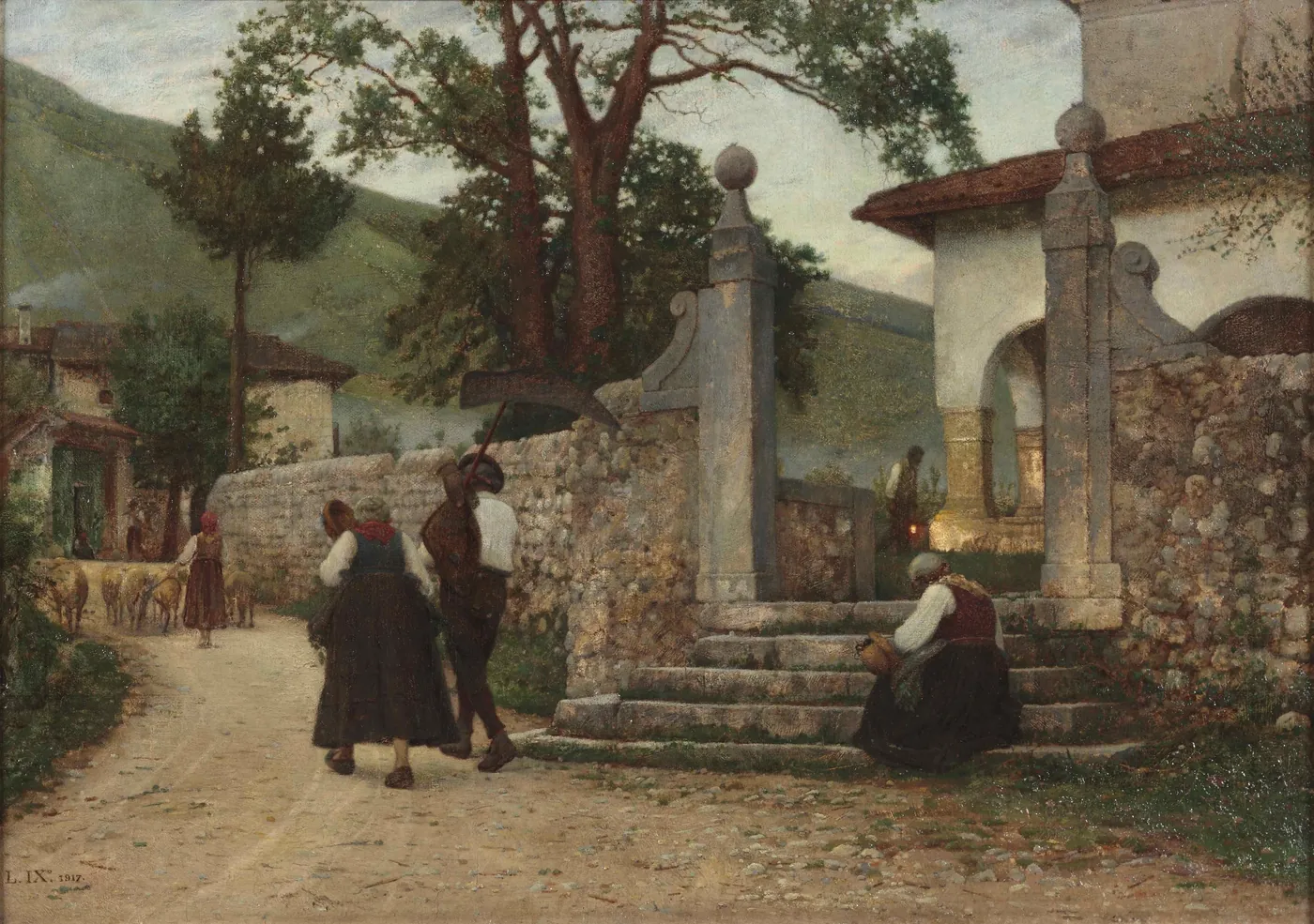

Polcenigo
Polcenigo grew up along the Gorgazzo below a castle hill, was Venetian for 377 years (1420–1797), and is now one of I Borghi più belli d’Italia, the association of Italy’s most beautiful villages.
- Neolithic
- A pile-dwelling village stood in the Palù wetland (Borghi più belli FVG).
- After 181 BC
- Having founded Aquileia, the Romans took the lands east of the Livenza (same source).
- 5th–6th c.
- Christianity spread, centred on the church of San Floriano (same source).
- 963
- First record of the castle: Emperor Otto I gave nearby lands to the bishop of Belluno (Borghi più belli FVG).
- 1000–1100
- The lords of Polcenigo received the castle and fief, later becoming counts (Borghi più belli FVG).
- 13th c.
- The church of San Giacomo and its Franciscan convent were built (MagicoVeneto).
- 1420
- Polcenigo passed to the Republic of Venice (Borghi più belli FVG).
- 1499
- An Ottoman raid left the village in ruins (same source).
- 1738
- The counts rebuilt the castle as a Venetian-style villa (Borghi più belli FVG).
- 1797–1866
- After Venice fell came Napoleonic and then Austrian rule, until Polcenigo joined Italy in 1866 (Borghi più belli FVG).
- Early 1980s
- The ruined castle passed to the municipality (FAI).
The castle. The “castle” on the hill is really an 18th-century villa, built from older stone and Sarone quarry stone. It is usually credited to the Venetian architect Matteo Lucchesi, though no document proves it (Borghi più belli FVG). The FAI gives a different early history, with a fire destroying the old castle in 1600 (FAI).
A staircase of 365 steps, perhaps over 10 m wide, once ran from its ballroom down to the village; its stones went into the church at Vigonovo. Inheritance quarrels emptied the villa in the mid-1800s, later owners stripped it for stone, and the earthquakes of 1936 and 1976 did the rest (Borghi più belli FVG).
The village. The old town follows the stream through a narrow valley between the castle hill and the San Floriano and Santa Lucia hills. The church of San Rocco dates from the 14th century, and its bell tower may once have been a tower in the town walls. The hamlets are Mezzomonte (once called Nuvolone and probably settled by Albanians), Coltura, Gorgazzo and San Giovanni (MagicoVeneto).
Festivals
- Sagra dei Thèst, the basket fair (first Sunday of September): held for more than 300 years. It began at the Santissima sanctuary, where farmers bought wicker baskets (theston) for the grape harvest, and now fills the village centre with crafts and local food (Borghi più belli FVG).
- Presepi, nativity scenes (mid-December to mid-January): set up in corners all over the village; best seen after dark (same source).
- Chestnut festival in Mezzomonte (autumn): walks follow the old paths where logs and hay were sledded down the mountain on sleds called sguoithe or sloithe (same source).
- Cyclamen festival in Mezzomonte (August): teams race to drag a sled loaded with hay bales to the finish (same source).
- Santa Barbara in Coltura (4 December): a mass and procession, run by a mutual-aid society founded in 1907 (same source).
How this became Friuli
Polcenigo sits on Friuli’s western doorstep. Friulians mark out their homeland with the saying De Livence al Timâf, from the Livenza to the Timavo (Treccani), and the Livenza rises here.
- Before Rome
- The Livenza divided the Veneti from the Celtic Carni (Visit Sacile).
- Roman era
- The name Polcenigo seems to come from a Roman landowner, Paucinius; its -igo ending may also point to a Celtic root (Pordenone with Love).
- 568
- The Lombards arrived and made Forum Iulii, today’s Cividale, the seat of a duchy. Its name spread to the whole territory and became “Friuli” (ARLeF).
- 774–828
- The Franks absorbed the duchy and in 828 reorganised it as the March of Friuli (Wikipedia).
- 963
- The castle of Polcenigo enters the records (see Polcenigo).
- 1077
- On 3 April Emperor Henry IV gave the patriarch of Aquileia a prince’s powers. The Patria del Friuli, between the Livenza and the Timavo, was the heart of his state (ARLeF).
- 1200s–1300s
- The patriarch’s councils grew into a parliament (Wikipedia).
- 1420
- Venetian troops entered Udine in June, ending the patriarch’s rule. Friuli then had about 150,000 people (Zannini, University of Udine).
- 1420–1797
- Venice sent a lieutenant to govern from Udine (Regione Storia FVG) and kept the old parliament, though with less power (ARLeF).
- 1797–1866
- Napoleon, then Austria, then Italy (see Polcenigo).
The Friulian spoken here
Friulian (furlan) is a language of its own, not a dialect of Italian, and Polcenigo speaks it at the very edge of its range, where it blends into Venetian.
- Where Friulian comes from It grew out of the Latin spoken around Aquileia, kept Celtic traces in its place names and vocabulary, borrowed some Germanic words, and took its shape between the 6th and 10th centuries (ARLeF).
- First writing Friulian words appear in documents at the end of the 13th century; in the 14th and 15th, accounts and notaries’ papers were written in it (ARLeF).
- Four families Central (Udine), eastern (Gorizia), Carnic (Tolmezzo) and western (Pordenone), with the Tagliamento as the main divide. About half a million people speak it actively (ARLeF).
- Polcenigo’s kind Western Friulian has a border belt where it shades into Venetian. That belt begins at the Livenza springs in Polcenigo and runs down to Bagnarola (Wikipedia).
- A mixture The linguist Theodor Gartner called the speech of Polcenigo, Budoia and Aviano Gemenge, “mixtures” of Friulian and Venetian, turning more Friulian as you go north. Giovanni Frau judged these dialects more Friulian than they sound to a casual ear (Treccani).
- What is Friulian in it Feminine words end in -a, long e and u have become diphthongs, and old clusters such as cl-, gl- and pl- survive (Treccani).
- What is Venetian in it The lisped “th” sound of the Livenza’s Venetian dialects (Treccani). You see it written in local words such as thèst (baskets) and sguoithe (sleds).
- The names In Friulian the village is Polcenic; locals just say Al Borc, “the village” (Wikipedia). Gorgazzo is said to come from Friulian gorc, an abyss (Komoot).
- Retreat Pordenone spoke Friulian in the 15th and 16th centuries and turned Venetian through its ties with Venice (Treccani). By 1932 the Enciclopedia Italiana judged that Venetian had overtaken Friulian along this foothill strip, Polcenigo included (Treccani, 1932).
- And return Since the late 1990s laws protecting Friulian have raised local pride in it, though Italian keeps gaining among the young (Treccani).
Local words
- pra
- meadowPra del Mulin, Pradulin, Pradussel
- mulin
- millPra del Mulin
- Al Borc
- “the village”, the locals’ name for PolcenigoEveryday speech
- gorc
- abyss, deep poolSaid to lie behind “Gorgazzo”
- furlan
- Friulian, the language and the peopleFriuli
- De Livence al Timâf
- “from the Livenza to the Timavo”, Friuli’s traditional boundsA Friulian saying
- Siega
- saw; the old name of the Vecchio MulinoVia Sega
- Molinat
- “wretched mill”, a scornful nicknameThe middle mill
- Gorgazzut
- “little Gorgazzo”, the Gorgazzetto channelA document of 1614
- battiferro
- water-driven hammer forgeThe Livenza forge
- pila da orzo
- barley hullerMills of the 1800s
- filatoio
- silk-throwing millThe Molinat site
- lavatoio
- public washhouseVia Sega
- peschiera
- fish pondBy the Livenza mill