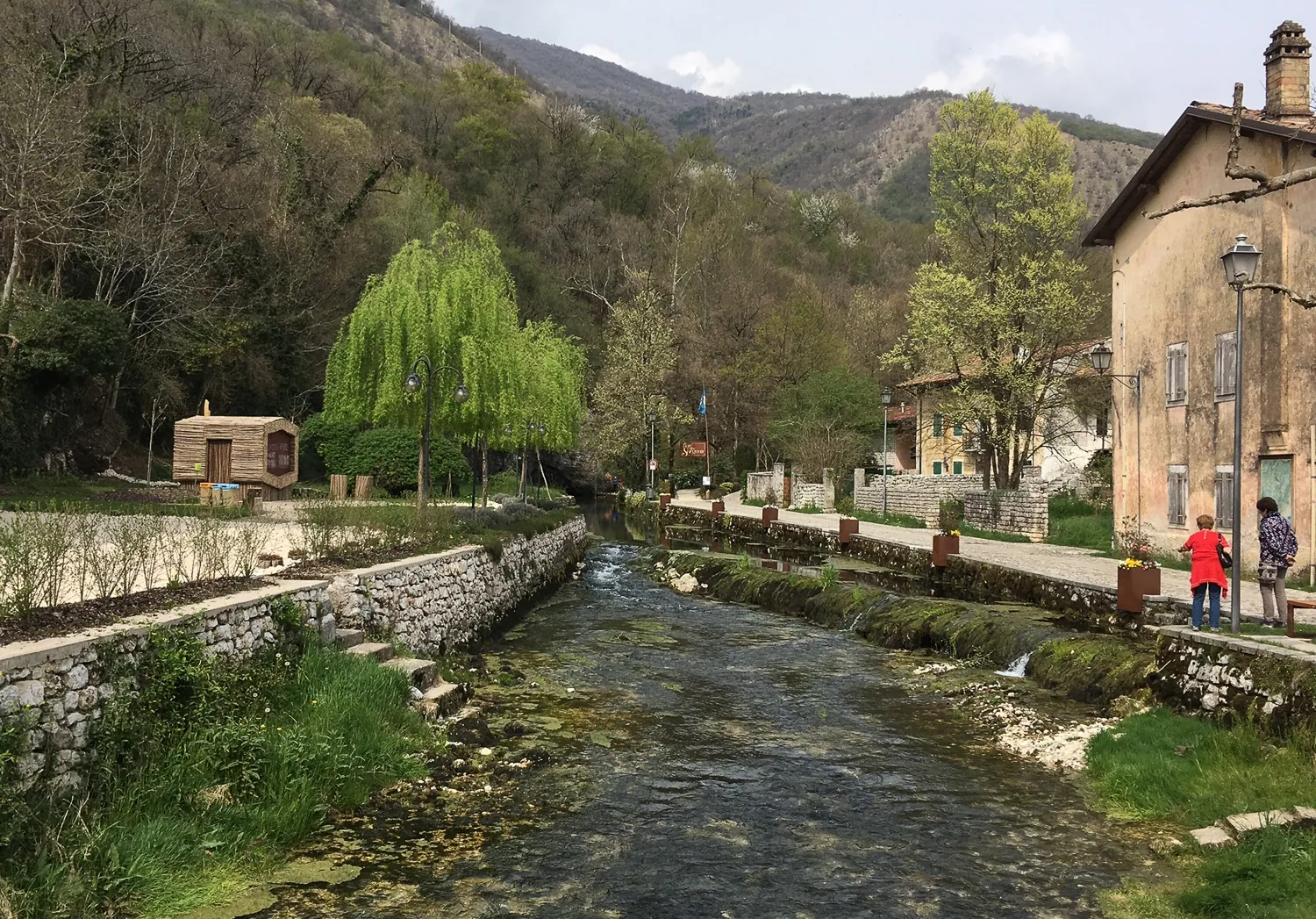

Visiting tips
- Walk it The spring is in the hamlet of Gorgazzo, about 1 km from Polcenigo’s centre, and the stream links the two (Borghi più belli FVG). An easy 9 km loop on mostly flat, paved roads takes in Polcenigo and the springs in 2–3 hours (MagicoVeneto).
- Look for the Christ On a sunny day with clear water you can make out the statue 9 m down near the entrance (Avvenire).
- See the old mill The Vecchio Mulino, Via Sega 1, is free but has no fixed hours: call ahead on +39 351 7178404 (Museionline).
- Get the official guide The panel’s QR codes open the PolceniGeo pages: the geo-guide download, a video of the spring and a 360° VR view.
- Eat and stay Al Bus is the place to eat at the springs, and the Albergo diffuso offers rooms spread around the village, with reception in Piazza Plebiscito, tel. 0434 1856016 (Avvenire).
- Diving Only for experienced cave divers, under the municipal rules of 2014 (panel).
- Come back for the basket fair on the first Sunday of September, or the nativity scenes from mid-December to mid-January (see Polcenigo).
Around the spring
Within a few kilometres of the Gorgazzo are a UNESCO prehistoric site, a pilgrimage church at the river’s source, Venice’s old oar forest and the river town that grew rich on the Livenza.
- Palù di Livenza (UNESCO) About 60,000 m² of wetland between Caneva and Polcenigo, part of the World Heritage “prehistoric pile dwellings around the Alps” since 2011 (Il Nordest). Its busiest period was 4500–3600 BC, when a village on piles was rebuilt in three phases. Digs have found more than a thousand piles and beams, a paddle fragment and an unfinished bailer: boats on these waters some 6,000 years ago (same source).
- Getting to Palù From Polcenigo, take via Roma to the church of San Rocco, then via Livenza to a dirt car park with information boards (Il Nordest).
- The Santissima sanctuary Legend says the Trinity appeared here in 437. From the 16th century it drew pilgrims praying for children; Venice closed its Franciscan convent in 1769, the counts bought it in 1772 and it passed to the parish in 1885 (Avvenire). Inside are a 1494 painting by Domenico da Tolmezzo and the Madonna del Latte, once venerated by women who struggled to breastfeed (same source).
- St Lucy’s spring By the Livenza’s source, an old shrine to St Lucy has a spring said to protect and heal the eyes if you bathe them (Avvenire).
- The Cansiglio forest The karst plateau above, at 900–1,000 m, is still a forest of beech, spruce and fir (Regione FVG). The Museo dell’Uomo in Cansiglio at Pian Osteria (Tambre) tells its human story, including the Cimbrian woodworkers who arrived from the Asiago plateau in 1799 and made beech boxes, sieves and cheese hoops (MUC).
- Sacile, “Garden of the Serenissima” About 80 km from Venice, its centre sits on two islands in the Livenza, lined with palaces built by Venetian nobles; Piazza del Popolo was the old river port (SiViaggia). The town joined Venice in 1419, and its 16th-century Palazzo Ragazzoni shares a name with the nobleman who ran eight water-powered works on the river in 1577 (same source; Visit Sacile).
- Cammino di San Cristoforo A walking route founded in 2018 between the Tagliamento and the Piave, with three waymarked lines. Its first stage runs from Caneva to Polcenigo, past the springs (Avvenire).
Italian words worth knowing
- el Buso, Bus
- “the hole” (dialect)The locals’ name for the Gorgazzo
- Gorgatio
- old form of “Gorgazzo”Documents from the 13th century
- sorgente, risorgiva
- spring; resurgence, where sunken water comes back upSigns and maps
- sifone, cavità a sifone
- sump; a cave passage full of waterDive records
- speleosub
- cave diverDive records
- troppopieno
- overflowThe panel’s flood photo
- geosito
- geosite, a protected geological siteThe panel’s title
- la Serenissima
- “the Most Serene”, the Republic of VeniceHistory
- Arsenale
- Venice’s state shipyardTimber and oars
- Bosco da Reme di San Marco
- St Mark’s oar forest, the CansiglioTimber and oars
- bosco bandito
- forest under a ban, closed to unlicensed useVenetian forest law
- faggio
- beechThe Cansiglio
- remo, remèr
- oar; oar-makerThe Arsenale
- stele
- poles cut for making oarsTimber transport
- risina
- wooden chute for sliding logs downhillTimber transport
- stua
- dam opened to flush logs downstreamTimber transport
- fluitazione
- floating timber down a riverTimber transport
- zattera, zattieri
- raft; raftsmenThe Piave and the Livenza
- trabaccolo
- Adriatic coastal sailing boatFrom river port to Venice
- mulino, molinetto
- mill; little millThe Vecchio Mulino; the Molinetto spring
- sega
- saw, sawmillVia Sega; the sega alla veneziana
- follo battipanni
- fulling mill for beating woollen clothPolcenigo’s old town
- maglio
- water-driven trip-hammerPolcenigo’s old town
- roggia
- mill race, a channel feeding a millThe Gorgazzetto
- thèst, sèst
- baskets (dialect)Sagra dei Thèst
- sagra
- village festivalThe September basket fair
- palafitte
- pile dwellingsPalù di Livenza
- presepi
- nativity scenesChristmas in Polcenigo
- sguoithe, sloithe
- sleds for logs and hay (dialect)Mezzomonte’s festivals