
Water at work
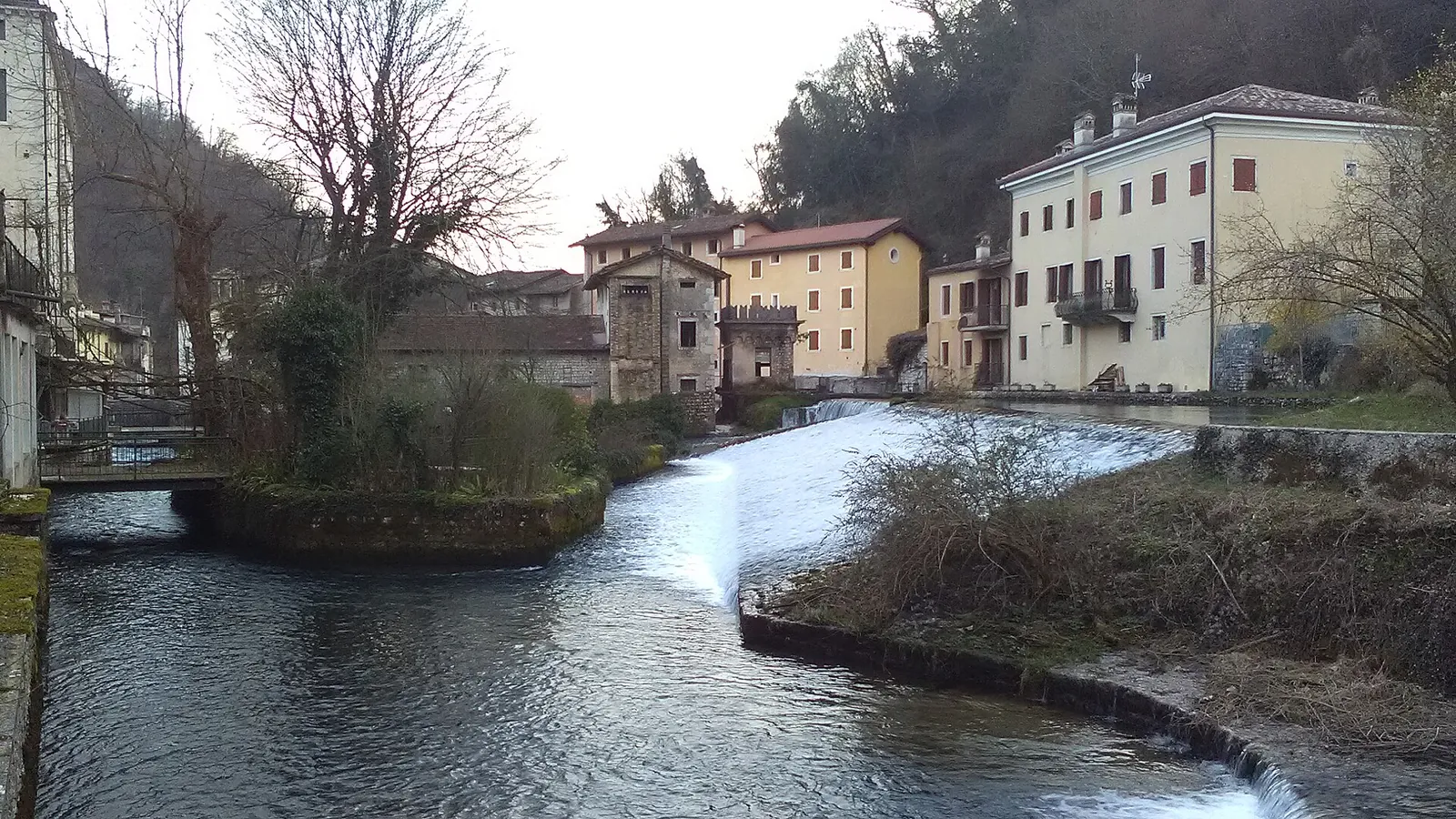
The Gorgazzo was Polcenigo’s engine. For centuries its fast, steady water turned the wheels of fulling mills, sawmills, grain mills and trip-hammers, while the Livenza itself was kept clear for boats.
- Why the mills sat on the Gorgazzo In the Middle Ages anything built in the Livenza’s bed was torn down because it blocked navigation. Mills, sawmills and hammer forges could only go on the smaller streams that feed it (Alto Livenza history, Impetodivino), and the Gorgazzo is one of them.
- The old town The houses that lean over the stream in Polcenigo once held mills, trip-hammers (magli) and fulling mills for beating woollen cloth (folli battipanni) (MagicoVeneto).
- The Vecchio Mulino The “old mill” on the Gorgazzetto channel belonged to the counts of Polcenigo. It is first recorded in 1481 as a fulling mill, then worked as a sawmill and finally as a grain mill. It stood outside the centre because fulling was loud and washing wool fouled the drinking water (Museionline).
- Saved in 1903 Luigi Lacchin bought the crumbling building in 1903 and restored it. It passed to his wife Teresa Curioni and then from mother to daughter to Angela and Elena Sanchini, who restored the millstones, gears, shafts and belts you can see today (Museionline). Its address, Via Sega, means “Saw Street”.
- Downstream at Sacile By 1577 a single nobleman, Giacomo Ragazzoni, owned eight water-powered works on the river there: mills, cloth works, paper mills and forges for swords (Visit Sacile).
- The Venetian sawmill The sega alla veneziana used a water wheel to drive a frame saw and push the log into the blade. On the Cansiglio’s Piave side, the sawn timber was loaded onto rafts for Venice (Museo dell’Uomo in Cansiglio).
- Into the 20th century Between the two world wars Polcenigo opened dairies at Polcenigo, Gorgazzo and Coltura and built a new hydroelectric plant (Borghi più belli FVG).
Pra del Mulin, the mill meadow
The name is local speech for “the mill meadow”: pra is a meadow and mulin a mill. No published history turned up under that exact spelling. The records that fit it are these, and they put mills right at the spring in the Middle Ages.
- Pradulin In 1752 a wall was built to keep water off a plot at a place called Pradulin, a few steps from the Gorgazzo spring (Fadelli). Pradulin looks like a worn-down form of the same name, though the source does not say so.
- Two mills at the spring Documents from the 1300s and 1400s record two mills on the first stretch of the Gorgazzo, about where the restaurant Da Genio stands today. There the stream splits in two, and one branch, probably man-made, runs under the building (Fadelli).
- Whose they were Both belonged to the counts of Polcenigo. One of them also had a fulling mill and a sawmill (same source).
- Gone by the 1600s They drop out of the records in the early 17th century. Only traces of the mill channel survive (same source).
- Every owner for himself There was no common flood plan: an 1808 record says each landowner had to defend his own ground, so walls like the one at Pradulin were built by those who could afford them (same source).
- A chapel with maize on the altar An 1894 description mentions a chapel at Gorgazzo whose altar was decorated with corn cobs left by worshippers (same source).
Every mill the Gorgazzo turned
Over the centuries Polcenigo had at least twelve mills, a hammer forge, three or four fulling mills and at least three sawmills, though never all at once (AD Polcenigo). The local historian Alessandro Fadelli has traced each one in Le acque di Polcenigo (2014), the main source here (Fadelli).
The Gorgazzetto. The key was a channel dug in the Middle Ages, before 1375, that takes part of the Gorgazzo just before today’s Piazza Plebiscito (AD Polcenigo). It runs under the houses of Via Coltura, and a document of 1614 calls it Gorgazzut (Fadelli). At least six works stood on it (AD Polcenigo).
On the Gorgazzo stream
- The Gorgazzo mills (at the spring): the two medieval mills described above.
- Mulino di Slas (Via Gorgazzo): named after Borgo di Slas, the upper quarter. Certain from the 1500s, with four wheels, later three. The counts leased it to millers. It stopped in the mid-1930s and was pulled down in the late 1950s.
- Mulino di Sottocroda (Via San Giacomo): “under the crag” of the castle hill, recorded from the early 1600s. Around 1925 the Massignani family added a small hydroelectric plant that ran until the early 1960s.
- Mulino della Sega, or Manin (Via San Rocco): a sawmill and a five-wheel mill. The Del Torso family of Udine passed it to the Manin in 1632. Still working in 1769, it was gone by the early 1800s, and the site is now a meadow.
On the Gorgazzetto channel
- Mulino Del Ponte (Via Coltura): recorded from the early 1500s. The counts gave it on perpetual lease to the Del Ponte millers, who ran it for centuries. It closed around 1939–1940 and became a house.
- Molinat, the middle mill (between Via Coltura and Via Roma): a one-wheel mill in such poor shape that old documents call it by a scornful name. In the later 1700s a silk mill replaced it, run by the counts and the doctor Carlo Carini, making silk cloth and stockings into the early 1800s.
- Mulino Fullini, now Modolo (between Via Coltura and Via della Rosta): recorded from the 1600s and perhaps medieval. With three wheels and 22 horsepower in 1877 it was the strongest in the village. The Modolo family ran it from 1911 to 1985, the last mill in Polcenigo to close, and its machinery survives.
- The Vecchio Mulino, Faletti-Sanchini (Via Sega): the one you can visit. Its story is set out year by year below.
- The Livenza hammer forge a battiferro with three wheels, certain from 1687 under Nicolò Beltrame. The Pianca family from Sacile bought it in 1905 and made iron and wooden tools. The last smith, Luigi Pianca, died in 1967, and the building collapsed in May 1984.
On the Livenza and at San Giovanni
- Mulino di Livenza (by the bridge): a mill on the Livenza is mentioned as early as 1222. It still had four wheels in the early 1800s, until works on the riverbed removed the drop that drove it.
- Mulino della Fontaniva (San Giovanni): built shortly before 1850 by the priest don Antonio Bravin, who left it to the parish. A hydroelectric cooperative bought it in 1923 and soon failed. It was demolished in the mid-1930s, and Via Molino keeps its memory.
- Mulino Curioni, later Rovere (San Giovanni): built between 1850 and 1861 as a rice huller, then a grain mill, then from 1903 a water-driven thresher. In the 1920s a small pasta factory was added.
The Vecchio Mulino, year by year
- 1481
- On 8 March the counts of Polcenigo bought a fulling mill from the master Daniel Zambon (Borgo Creativo).
- 1608
- Count Marsilio leased it to Gio Batta del Torso of Udine, whose family put expert fullers in charge.
- About 1738
- The counts built a water-driven sawmill beside it.
- 1830–1850
- The Austrian land register lists a saw and a water mill owned by Giuseppe di Polcenigo.
- 1877
- A survey of Friulian mills records it as the mill della Siega, “of the saw”: two maize stones, a 1.65 m fall, 17.6 horsepower.
- 1903
- Luigi Lacchin bought the run-down building from Countess Margherita Polcenigo and rebuilt it; mill and saw were working again by 1913.
- 1985
- Carlo Rosset, the last miller, stopped the stones.
- 1990
- The saw was dismantled and sold to Russia.
- 2016
- The restored mill opened on 22 May (all from Borgo Creativo).
Why the wheels stopped. Several works shut between the two world wars for lack of trade. An electric mill built at San Giovanni around the 1920s may have dealt the final blow to the water mills (AD Polcenigo).
Living with the water
The same water that drove the mills also flooded the fields, fed fish ponds and, for a while, grew rice (all from Fadelli).
- 1612
- A fish pond beside the Livenza mill paid its rent in trout.
- 1714
- The Rui de Brosa torrent damaged a wall on St Roch’s day.
- 1738
- The same torrent knocked down one of the town gates.
- 1760
- A field near the Gorgazzo lost value after repeated flooding.
- 1790–1800
- The confraternity of San Rocco paid for banks against the Gorgazzo’s erosion.
- Around 1800
- Rice was probably grown at Pradussel, the wet ground near San Rocco. Mills of the time had rice hullers. It did not last, perhaps because of malaria.
- 1825
- The counts carried out works on the Gorgazzo and the Rui de Brosa.
- After 1894
- Public washhouses went up in Via Sega, outside the village, as part of the fight against epidemics.
- 1941
- On 12 June the Mena torrent flooded Coltura, with damage put at more than 100,000 lire.
Trout are still farmed at San Giovanni today.