The descent
Dive the Gorgazzo along its real route, from the pool to 222 m. Move your light over the rock as you go down.
The route follows the regional cave register’s survey. The paintings are imagined, made with AI in the manner of Luigi Nono’s 1872 view of the spring; they are not photographs of the cave.
Scroll to dive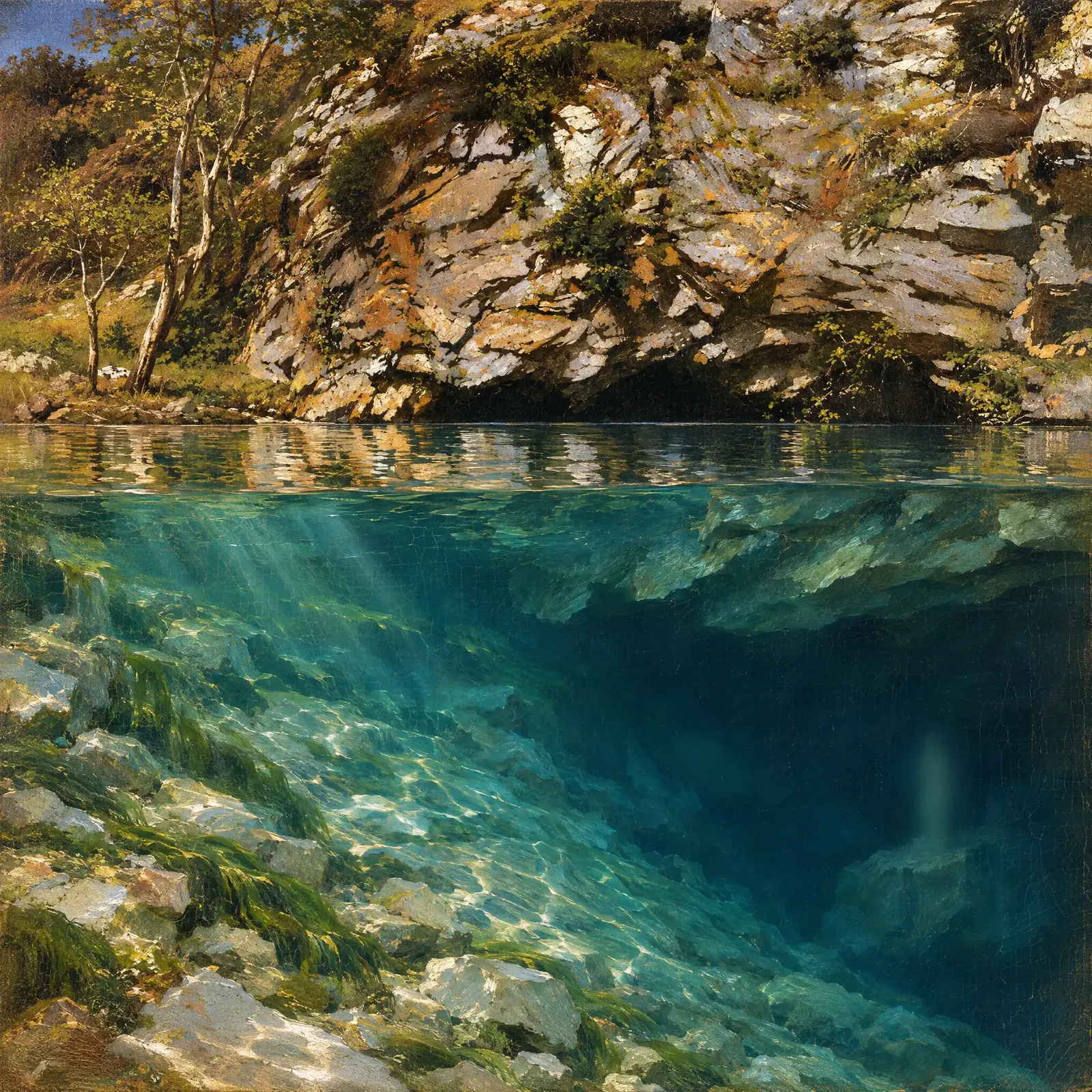
0 to 18 m: the pool and the entrance slope 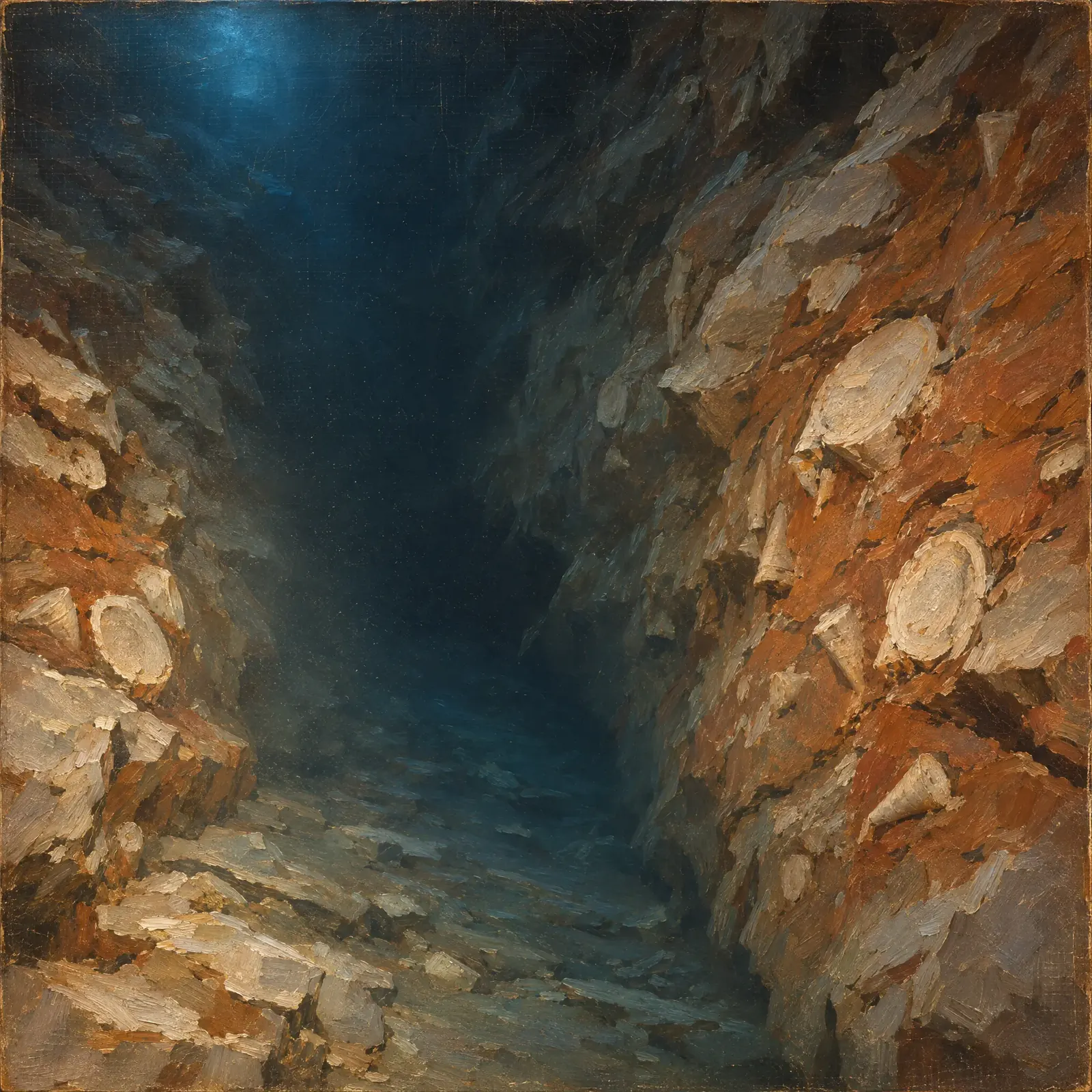
18 to 42 m: the first passages 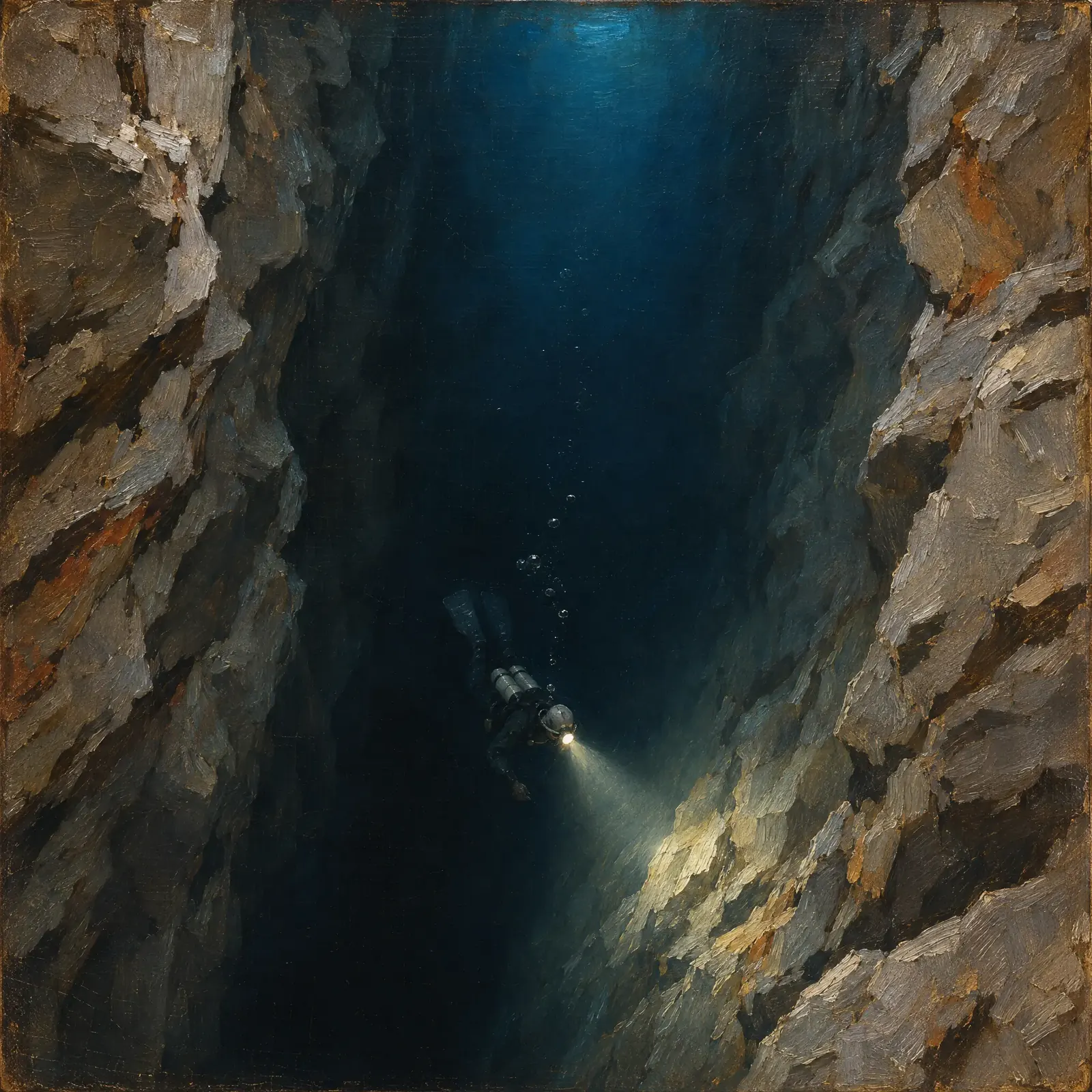
42 to 87 m: the shaft 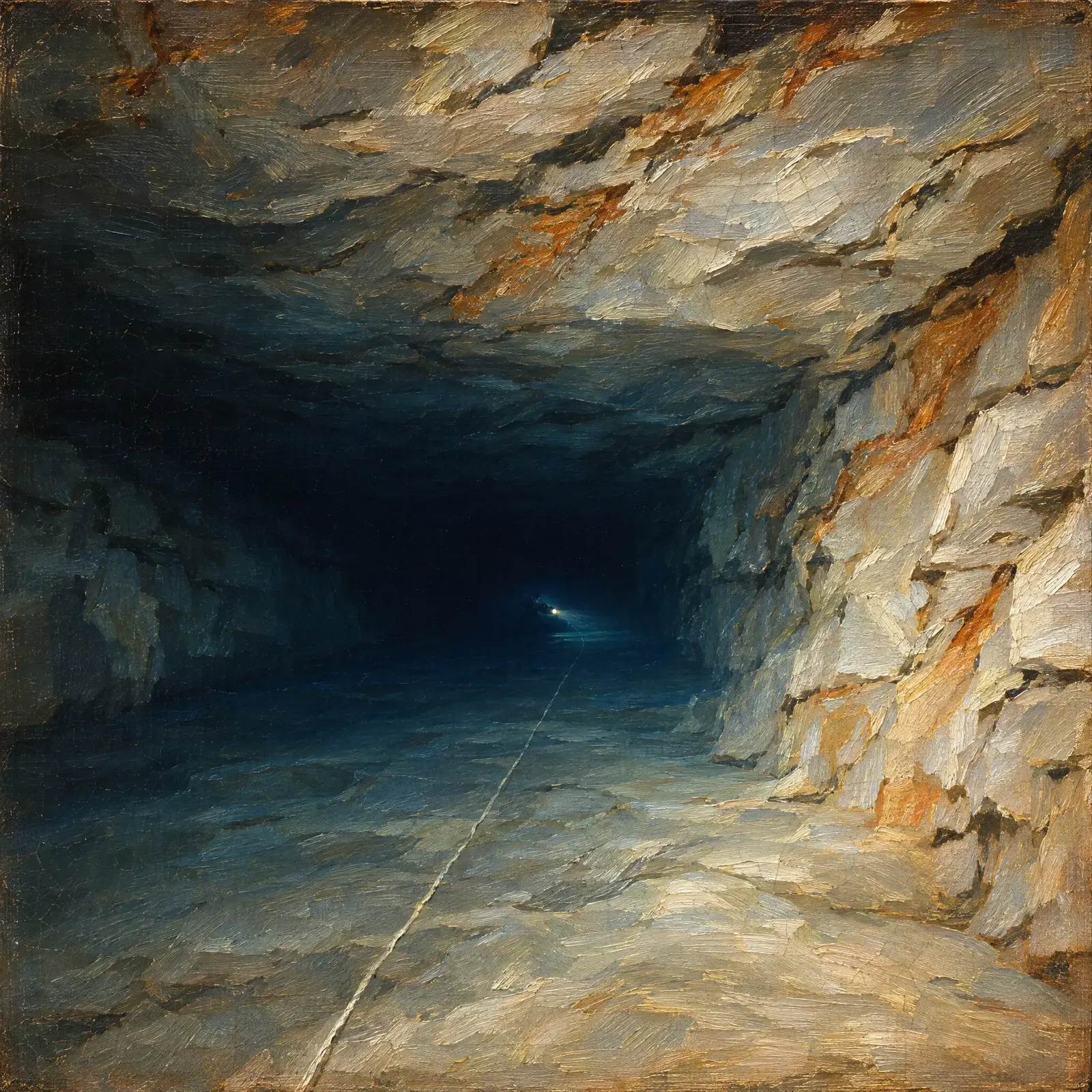
87 to 125 m: the long gallery 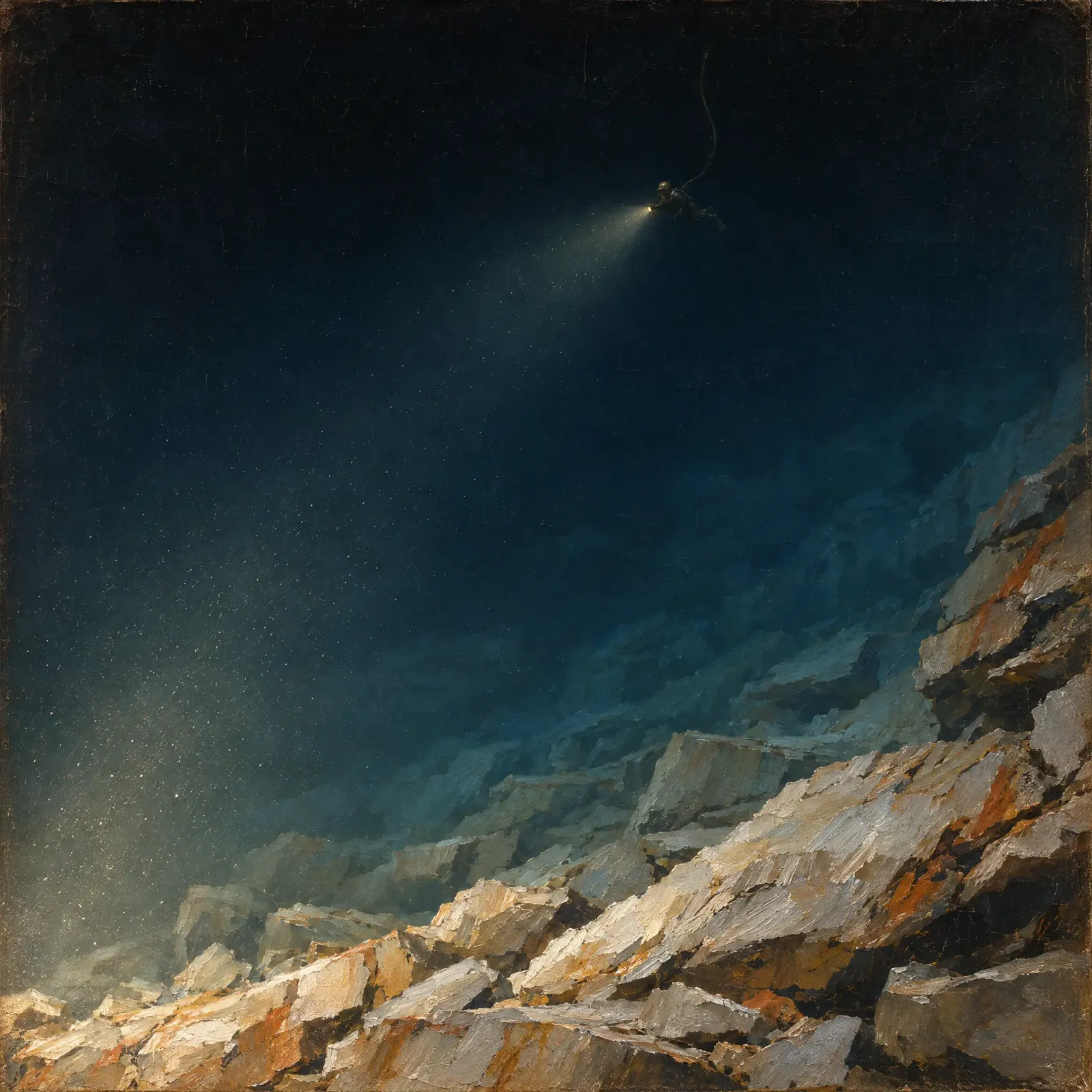
125 to 160 m: the great chamber 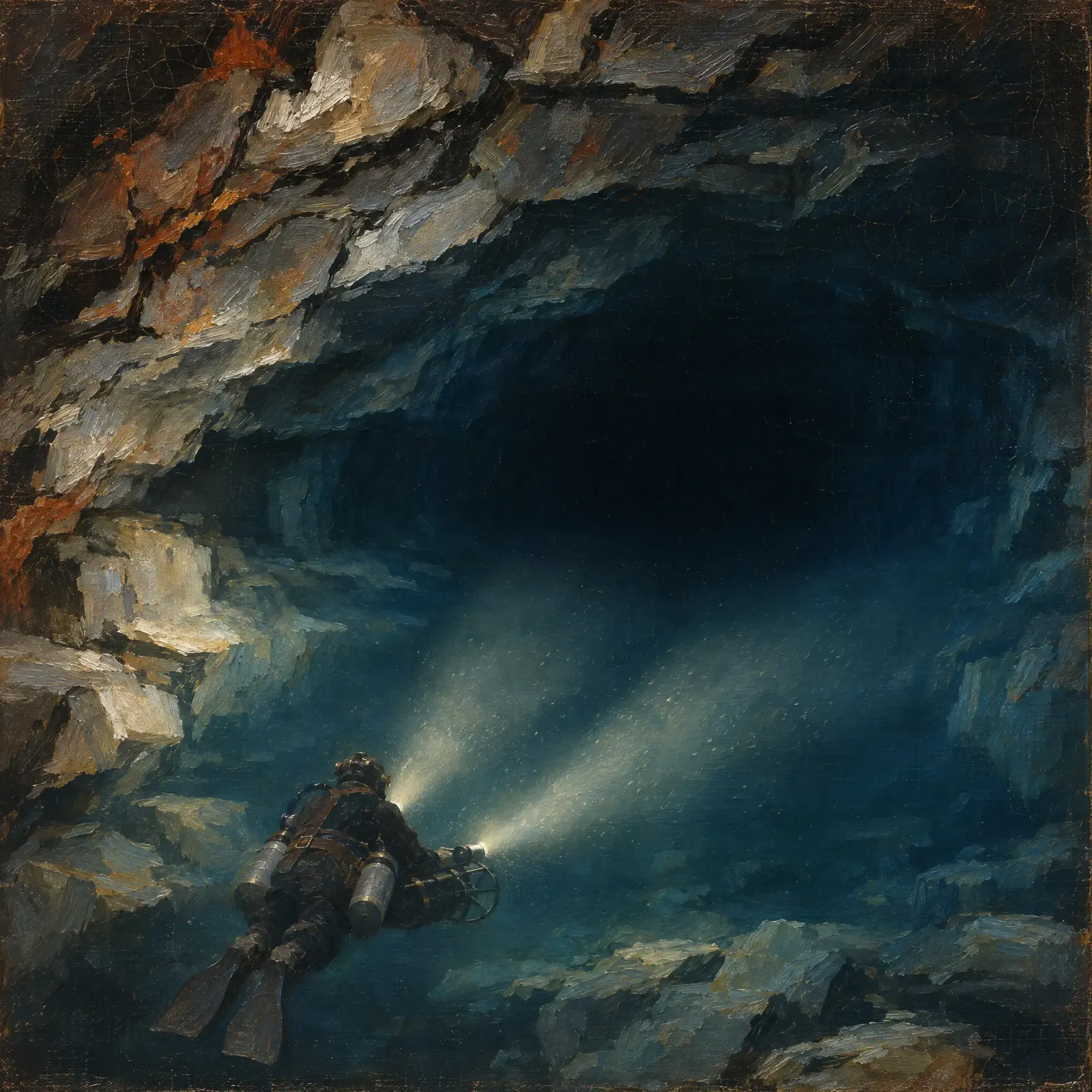
160 to 222 m: the end of the known cave
Everything on the way down
- 0 mThe surfaceThe pool lies 52 m above sea level, about 1 km from Polcenigo. Over the mouth of the cave its water turns from emerald to turquoise (cave register; MagicoVeneto).
- 9 mThe statue of ChristA statue of Christ stands near the entrance. When the water is clear you can see it from the bank. Every Christmas it is cleaned and a floating nativity scene is set on the pool (Borghi più belli FVG).
- 21 m1964, the first recorded diveOn 13 December 1964 a diver of the Circolo Idrologico Speleologico Friulano reached 21 m, the first dive with a reliable record (panel).
- 27 mThe first passagesFrom the pool the cave slopes down to about 27 m, then loops through narrow passages. Reddish rudist fossils show on the walls of these first shafts: the trace of a tropical sea that covered the area until 65 million years ago (survey; panel).
- 42 mThe shaftAt 42 m the cave drops almost straight down, to 87 m (survey).
- 52 mSea levelFrom here down the cave lies below the level of the sea. Its deepest known point is about 170 m below it (cave register).
- 64 m1967, G. CobolIn May 1967 G. Cobol reached 64 m (panel).
- 80 m1967, three diversLater that year W. May, C. Hayes and S. Piccini reached 80 m (panel).
- 87 mThe long galleryAt the foot of the shaft a gallery runs off under the mountain, sloping gently down for well over a hundred metres (survey).
- 90 m1974In August 1974 R. Carbonere and A. Fileccia reached 90 m, according to a local history (Borghi più belli FVG).
- 98.6 mSt Mark’s CampanileVenice’s bell tower is 98.6 m tall. Standing at this depth, its golden angel would just reach the surface. It is drawn on the map at the same scale.
- About 100 mA chamber nobody has enteredOn attempts in 2015, 2016 and 2017 Luigi Casati reported a large unexplored chamber rising from about 100 m (Borghi più belli FVG).
- 106 m1987, past 100 mThe cave register’s survey marks Jean Jacques Bolanz at 106 m, 220 m from the entrance. The panel gives 108 m that year and credits L. Russo and M. Martini (survey; panel).
- 117 m1988, BolanzBolanz reached 117 m the following year (Borghi più belli FVG).
- 131 m1992, the great chamberOn 31 December 1992 Bolanz and his team reached 131 m, 320 m from the entrance, where the gallery opens into a large chamber. On the same expedition Casati explored a side branch between 90 and 104 m (survey; panel).
- 189 m15 February 2008, CasatiLuigi Casati reached 189 m, 400 m from the entrance (survey).
- 212 m23 February 2008, CasatiEight days later he reached 212 m, 440 m from the entrance. At the time no flooded cave in Italy had been explored deeper (survey; panel).
- 222 m2019, StarnawskiOn the morning of 5 September 2019 the Polish cave diver Krzysztof Starnawski reached 222 m, still the record. The dive took about two hours, and large galleries carried on beyond him (Scubaportal; Seacraft; panel).
No bottom yet
Nobody knows how deep the Gorgazzo goes. The regional cave register lists 700 m of surveyed passages in three dimensions and 440 m in plan (cave register), and in 2026 the municipality’s PolceniGeo project used dives to document the deepest parts in 3D for schools and the public (Tecnoandroid).
In February 2024 a Polish team led by Bartek Pitala went 5 m deeper than the Gorgazzo record in the Elefante Bianco cave in Veneto, now Italy’s deepest explored spring (Divers24). Measured by robot rather than by diver, the Pozzo del Merro sinkhole near Rome reaches 392 m (Scubaportal).
Diving here. The dive is feared for its depth, its cold and its strong internal currents. After a fatal accident in autumn 1995 the spring was closed to divers; diving reopened in 2014 under a municipal resolution (Borghi più belli FVG; panel).
How it is made
The route is the main line of the survey in the regional cave register (Catasto Grotte FVG no. 61), traced at its own scale; distances from the entrance are the survey’s. The map leaves out the side passages.
The paintings are imagined. They were made with AI image generation, using Luigi Nono’s 1872 Le sorgenti del Gorgazzo as the style reference and the survey, the panel and divers’ accounts for what each stretch holds. They are not photographs of the cave, and the statue is left indistinct because its form isn’t documented here.
Pressure is worked out from depth for fresh water. The bubble shows how a litre of air from the surface shrinks under it (Boyle’s law), the reason divers breathe special gas mixes this deep.