
Picture gallery
Tap any picture to enlarge it. The pictures load from the sites that hold them, credited under each one.
Luigi Nono’s paintings of this area
Old photographs, postcards and maps
Luigi Nono at Polcenigo
The painter Luigi Nono (1850–1918) grew up in Sacile and came back to Polcenigo all his life. His 1872 view of the Gorgazzo spring is the best-known picture ever made of this place.
- Who he was Born at Fusina, near Venice, on 8 December 1850. His family moved to Sacile, on the Livenza, in 1852. He entered the Venice academy in 1865 and finished in 1871 (Treccani). The composer Luigi Nono was his grandson (Il Giornale dell’Arte).
- Back to Sacile He returned to live with his family in 1872 and painted the Gorgazzo that year. After his father died in 1879 he settled in Venice for good, but kept his Friulian friends, among them the painter Domenico Mazzoni of Caneva (Dizionario biografico dei friulani).
- Why these pictures matter He showed three Polcenigo landscapes at the Brera exhibition in Milan in 1873. The critic Camillo Boito saw in them the birth of the modern Venetian school (Treccani).
- Where he painted Mostly at Coltura, at the Gorgazzo and at the Santissima (Polcenigo.org).
- His death He died at his house on the Zattere in Venice on 15 October 1918 (Treccani); some sources give 17 October.
His pictures of this area
- 1872
- Le sorgenti del Gorgazzo (The springs of the Gorgazzo), oil on canvas. Shown at Brera in 1873 (no. 156) and bought by the Venetian collector Michelangelo Guggenheim. Now in a private collection in Venice (Treccani). An oil study of the same year also survives (see both at Borgo Creativo).
- 1872
- A Coltura. Ca’ Pesaro, Venice’s modern art gallery (Soloarte gallery).
- 1873
- Sull’Ave Maria a Coltura (At the Angelus, Coltura). Brera 1873, no. 244. Private collection, Venice (Treccani).
- 1873
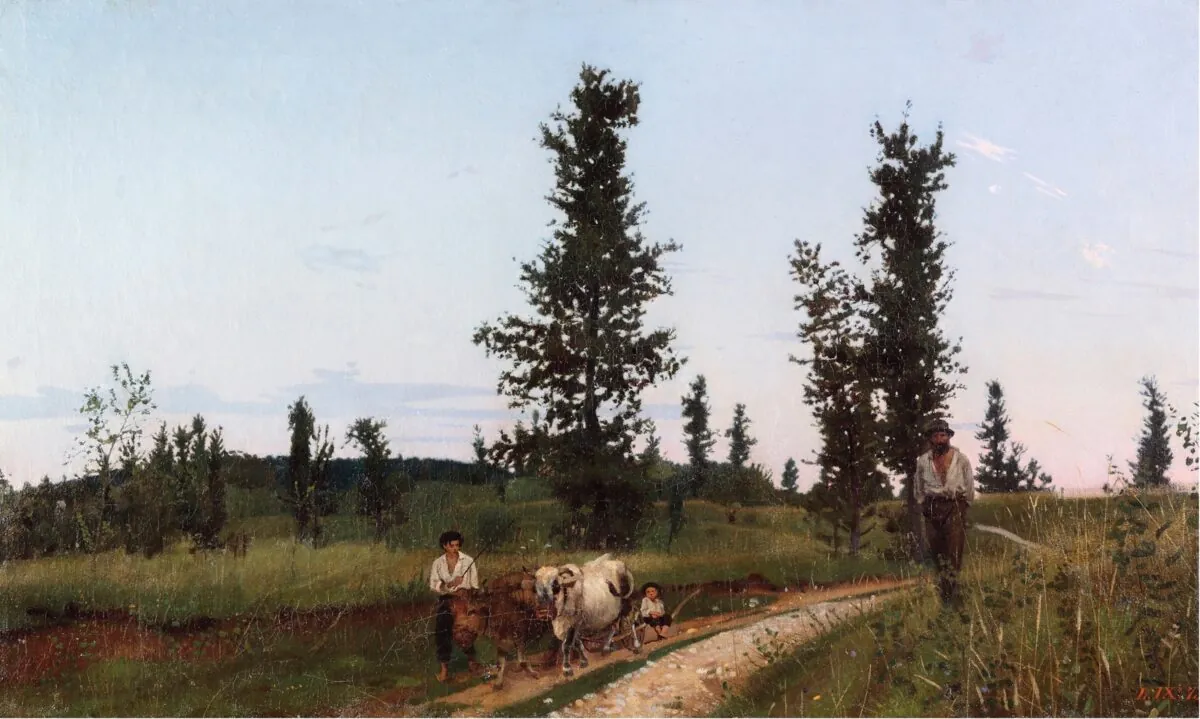
- Verso sera presso Polcenigo (Towards evening near Polcenigo). Brera 1873, no. 245 (Treccani). Oil on canvas, 58 × 97 cm, signed “L.IX° 73” (Nowarc).
- 1873
- Verso sera a Coltura. Private collection, Venice (Dizionario biografico dei friulani).
- 1873
- Ritorno dai campi (Return from the fields), painted near Polcenigo (Polcenigo.org).
- 1875
- La fanfara dei granatieri (The grenadiers’ band), painted on the plain of Sacile (Tutt’Art).
- 1876
- La chiesa di San Rocco a Polcenigo (Soloarte gallery).
- 1876
- La foresta del Cansiglio. Ca’ Pesaro, Venice (Soloarte gallery). His drawing of the forest ran in L’Illustrazione Italiana on 23 September 1877 (Dizionario Sartori).
- 1878
- Il mattino della sagra (The morning of the fair), a lively crowd in front of Coltura’s church. Shown at the Paris Universal Exhibition (Treccani).
- 1880
- Verso sera sul Livenza (Evening on the Livenza), near the Santissima (Polcenigo.org). Shown at Brera in 1880 and now lost (Treccani).
- 1894
- Nozze a Coltura (Wedding at Coltura) (Soloarte gallery).
- 1897
- Funerale di un bambino (A child’s funeral). Shown at the second Venice Biennale and in St Petersburg in 1898; bought in 1901 by Empress Maria Feodorovna, mother of Tsar Nicholas II (Polcenigo.org).
- 1909
- Prima pioggia (First rain), set at Coltura. Venice Biennale (Polcenigo.org).
- About 1912
- The Gorgazzo near its spring, reproduced in Fadelli’s book (Fadelli), and Polcenigo (1912) (Il Giornale dell’Arte).
- 1915
- In riva alla sorgente del Gorgazzo (On the bank of the Gorgazzo spring) (Soloarte gallery).
- 1917
- Ave Maria a Coltura, a return to his subject of 1873 (Soloarte gallery).
Where to see them
- At Coltura, in person The church of San Lorenzo, which Nono painted again and again, keeps full-size reproductions of Funerale di un bambino and Sull’Ave Maria a Coltura. Four outdoor installations with QR codes show the very views he painted. The project was finished at the end of 2023 (Il Giornale dell’Arte).
- Online The Borgo Creativo page on the spring shows the 1872 painting and its study. The Soloarte gallery has about a hundred of his works. Wikimedia Commons has the Gorgazzo painting and a page built on his 2006 catalogue raisonné.
- In print Giovanni Granzotto, Luigi Nono (1990), and Paolo Serafini’s catalogue raisonné (2006).

Other painters of these waters
The local historian Alessandro Fadelli names three painters above all for the waters of Polcenigo: Nono first, then Maria Ippoliti Sbrojavacca and Vittore Antonio Cargnel (Fadelli).
- Maria Ippoliti Sbrojavacca (Udine 1861–1932). She trained in Venice from 1888 in Domenico Bresolin’s landscape class and showed Crepuscolo gelido at the 1899 Venice Biennale, where Ca’ Pesaro acquired it. In 1901 she married Giuseppe di Sbrojavacca and moved to Polcenigo, into a 16th-century palace of the Polcenigo nobles. There she painted the Livenza’s waters, working near Sacile alongside Nono and Cargnel (Dizionario biografico dei friulani). Her painting of houses at the Gorgazzo is reproduced in Fadelli’s book (Fadelli). A 2009 exhibition in Udine brought her back from near oblivion (Messaggero Veneto).
- Vittore Antonio Cargnel (Venice 1872–Milan 1931). He moved inland to Sacile in 1901 and made his name with landscapes of the countryside there (Fondazione CRTrieste). Look for Mulino sul Livenza (Mill on the Livenza, 1910) (Acquisto Arte) and his 1921 painting of Sacile’s bird fair, the Sagra dei Osei (Berardi Arte). The regional heritage catalogue has three of his paintings online.
- Pietro Quaglia (1810–1882), engineer, agronomist and garden designer. He etched the castle around the middle of the 1800s (Gruppo Archeologico Polcenigo) and laid out the Italian garden of Palazzo Salice Scolari (Il Turista).
- Ermanno Varnier His drawings, published as Polcenigo nei disegni di Ermano Varnier, include the castle as it stood in the early 1800s (Gruppo Archeologico Polcenigo).
- Serena Nono The painter’s great-granddaughter showed her own landscapes and portraits at Polcenigo in 2024 (Il Giornale dell’Arte).
Art and stories
The Gorgazzo’s colour has drawn writers and painters for 150 years, and the springs carry a few good stories of their own.
- Marinelli’s visit The geographer Giovanni Marinelli toured the Livenza springs and the Cansiglio on 23–25 July 1876 and published his account in the Italian Alpine Club’s bulletin in 1877. He found the Gorgazzo a round basin 10–12 m across and measured its water at 10.9 °C (Marinelli, reissued by Baccichet). His line about “that patch of liquid sky” is the one quoted on the panel.
- A castle for the owls Marinelli found the counts’ palace on the hill long abandoned, its rooms given over to rats and owls (same source).
- Ransom for the Turks He also records that in 1607 the counts of Polcenigo had to sell part of their fief to ransom two of the family captured fighting the Ottoman Turks (same source).
- Luigi Nono’s painting In 1872 the painter Luigi Nono made Le sorgenti del Gorgazzo, showed it at the Brera triennial the next year, and sold it to the Venetian collector Michelangelo Guggenheim (Borghi più belli FVG).
- A quarrel over a Madonna The parishes of Coltura and Polcenigo disputed the Santissima’s Madonna del Latte until 1922, when it was settled in Coltura’s favour (Avvenire).
Older art in the churches
- The Santissima A Holy Trinity carved and painted in 1494 by Domenico da Tolmezzo, among his finest works, with four adoring angels he painted himself (Borghi più belli FVG). It sits in a grand 17th-century wooden altar (Il Turista).
- San Floriano (on its hill): 14th-century frescoes attributed to the school of Vitale da Bologna or Tommaso da Modena (In Italy).
- San Giacomo (below the castle): the church of a Franciscan convent already standing in 1262, with 14th-century frescoes, 18th-century paintings and an organ by the Venetian Giacinto Pescetti (Itinerari e sapori FVG). It also keeps a delicate fresco of the nursing Madonna, moved from the old church of Ognissanti (Borghi più belli FVG).
- San Lorenzo, Coltura founded in the 13th century and reshaped between 1890 and 1908 (I Borghi più belli d’Italia), so Nono’s early pictures show it before the rebuilding. Inside are works by Bettini and Tizianello (In Italy).
- San Giovanni paintings by Dall’Oglio and Valvasori (In Italy).
Old maps, prints and drawings
- 1753
- A map of Friuli from La Patria del Friuli descritta ed illustrata shows the Polcenigo area with a “Lake of Livenza” where the Palù wetland is now (Fadelli, fig. 35).
- 1764
- A privately owned map shows the mill on the Livenza (Fadelli, fig. 46).
- Late 1700s
- Drawings from the Manin family’s land register show the meeting of the Livenza and the Gorgazzo and the streams at San Giovanni (Fadelli, figs 8, 14, 20, 26; Curioni archive).
- Early 1800s
- The castle before its ruin, in Ermanno Varnier’s drawing (Gruppo Archeologico Polcenigo).
- About 1830
- Napoleonic and Austrian land-register maps mark every mill. Extracts are on the Borgo Creativo mill pages.
- Mid-1800s
- Pietro Quaglia’s etching of the castle (Gruppo Archeologico Polcenigo).
- 1877
- Nono’s drawing of the Cansiglio forest in L’Illustrazione Italiana (Dizionario Sartori).
Old photographs and postcards
These are the dated pictures that turned up, oldest first, with where each is published.
- Early 1900s
- A woman in Via Giuliana, Gorgazzo, carrying water buckets on a shoulder yoke. Postcard, Gianfranco Martello collection (Fadelli, fig. 10).
- Early 1900s
- The Sottocroda mill, and the Livenza hammer forge in the background of another view. Postcards, Martello collection (Fadelli, figs 40 and 47).
- 1909
- Washerwomen on the Gorgazzo in the middle of Polcenigo. Postcard posted in 1909, Martello collection (Fadelli, fig. 25).
- About 1920
- The castle, from the postcard set Polcenigo that the Pro Loco printed in 1973 for the village’s thousandth anniversary; also a private photo of 1920 (Gruppo Archeologico Polcenigo).
- 1930s
- The washhouse at San Giovanni di Polcenigo. Postcard (Fadelli, fig. 12).
- 1938
- The village band outside Casa Tizianel. Nilo Tizianel collection (Gruppo Archeologico Polcenigo).
- 1950
- Two views of the Gorgazzo spring. Moreno Scandolo collection (Borgo Creativo).
- 1953–1954
- Postcards of the Locanda al Gorgazzo (1953) and a panorama of Polcenigo posted in 1954, seen in postcard listings.
- 1961–1969
- The spring in 1961, 1964 and 1969. Scandolo collection (Borgo Creativo).
- Undated
- Washerwomen at the Gorgazzo, a view credited “Foto Missinato”, and more Scandolo postcards (Borgo Creativo).
- 1980s
- The Gorgazzo waterfalls in Polcenigo, photographed by Marco De Martin (Fadelli, fig. 22).
Where the collections are
- Moreno Scandolo A collector with at least 600 old postcards and photographs of Polcenigo, gathered over some twenty years. In 2014 he founded the Facebook group Sei di Polcenigo se… to share them, and he has shown panels at the basket fair (Il Gazzettino). This is the biggest pool of old pictures of the village.
- Borgo Creativo Polcenigo Its pages on the spring and on each mill have a “how it was” gallery of old photos and map extracts.
- Fadelli, Le acque di Polcenigo. A free PDF with 48 pictures: postcards, land-register drawings, old maps and the paintings by Nono and Ippoliti.
- Paolo Da Ros His historical photos of Polcenigo are published on the Residenza dei Tolomei site.
- CRAF, Spilimbergo The regional photography centre holds Michele Cendamo’s archive, including 600 colour slides of Pordenone, Polcenigo, Sacile and the foothills (Italian photography census).
- Regional heritage catalogue The Friuli Venezia Giulia catalogue is searchable for photographs, postcards and paintings by place name.
- State heritage office The Soprintendenza’s photo archives list Polcenigo and Sacile among the places they cover.
- Civic library, Coltura It has hosted shows of historical photos of Polcenigo, Coltura and San Giovanni (L’Artugna).
- Gruppo Archeologico Polcenigo Its bulletins reproduce old drawings, etchings and photos of the castle.