
What it is
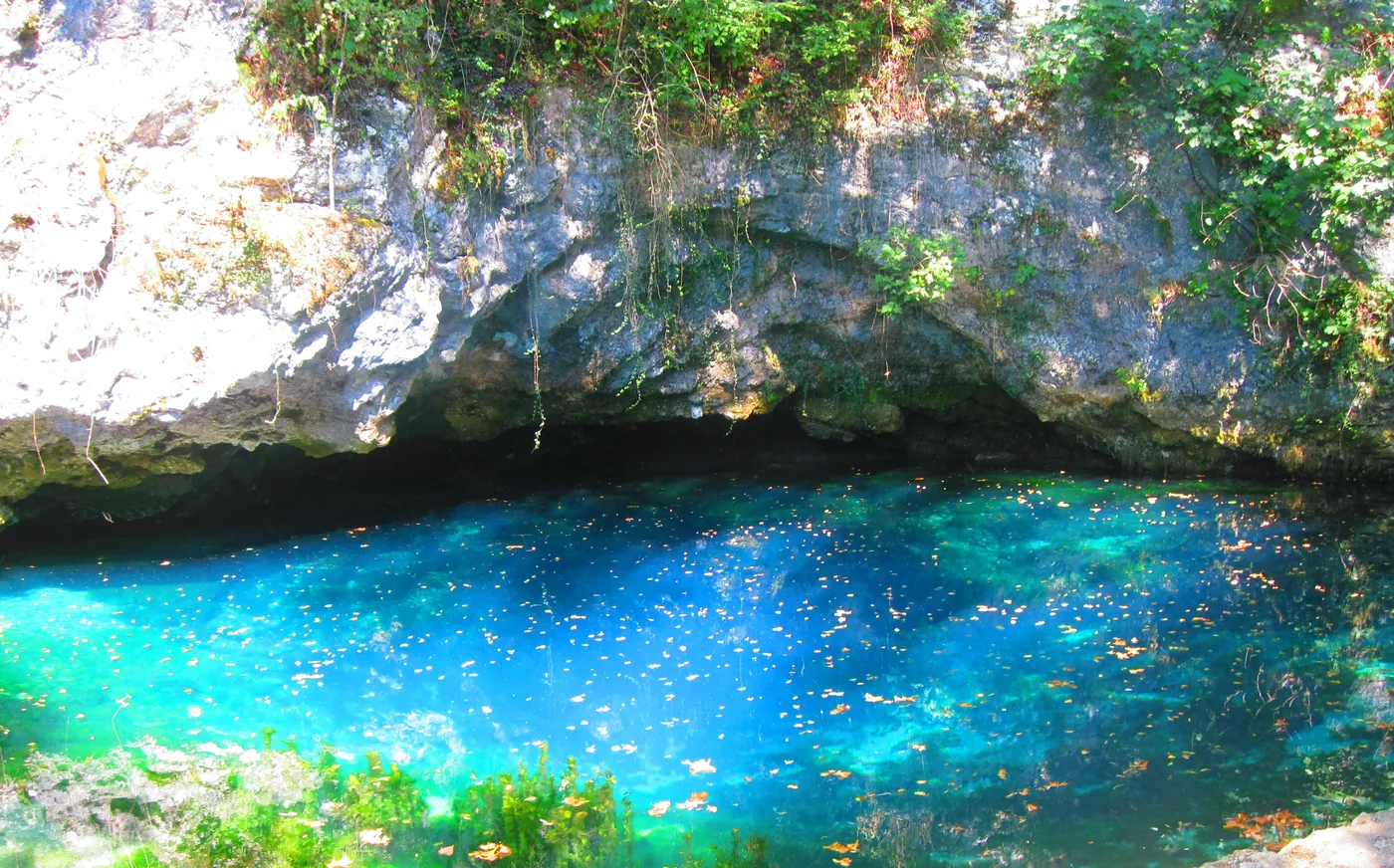
The Gorgazzo is the mouth of an underground river. Rain falling on the karst mountains above sinks through the limestone and rises here as a deep, icy pool about 1 km from Polcenigo (Borghi più belli FVG).
How it formed. Water gathers in a conduit beneath the mountain and resurfaces in a pool whose level follows the weather. Erosion opened the shaft along a fault that crosses the area, and the pool itself formed when a vault collapsed under water pressure (Pordenone with Love).
Where the water comes from. The Cansiglio plateau above averages about 1,777 mm of rain a year (measured at Crosetta), and its groundwater resurfaces in the Livenza springs (Regione FVG). The Gorgazzo, though, seems to drink from a different part of the mountain than its neighbours:
- From 20 September 2008, hydrogeologist Valentina Vicenzi (University of Ferrara) released two harmless dyes on the plateau: uranine at the Col de la Rizza abyss and Tinopal at the Bus de la Genziana.
- Over a year and more than 1,000 samples, uranine reappeared at the Santissima and Molinetto springs, but neither dye reached the Gorgazzo.
- Her working hypothesis is that the Gorgazzo drains Monte Cavallo instead (Borghi più belli FVG). The panel reports the same result from tests in 2007 and 2016.
The name. Locals call it el Buso (or Bus), dialect for “the hole”. Documents since the 13th century call it Gorgatio, which wore down over time into Gorgazzo (MagicoVeneto).
The colour. It runs from red rock banks through emerald algae to turquoise over the mouth of the shaft (MagicoVeneto). In 1877 the geographer Giovanni Marinelli (1846–1900) called the pool “a patch of liquid sky”.
How it behaves. It is an overflow spring: water only runs off when the pool spills over its lip. After ten days or so without rain the stream bed below can run dry while water keeps flowing underground (panel). The stream winds about 1,750 m into Polcenigo, dropping over small waterfalls, then roughly 1,500 m more to meet the Livenza near the Santissima (Borghi più belli FVG).
- Altitude of the pool
- 52 m above sea level Cave register
- Explored depth
- 222 m (2019) Scubaportal
- Deepest known point
- about 170 m below sea level Cave register
- Surveyed passages
- 700 m in three dimensions, 440 m in plan Cave register
- Stream to Polcenigo
- about 1,750 m Borghi più belli FVG
Into the depths
Divers have pushed the Gorgazzo from 21 m in 1964 to 222 m in 2019, and nobody has yet found the bottom.
Go down the shaft metre by metre: the descent
Each dot is a new depth record. The blue drop is Casati’s 2008 dive, the biggest single gain; the line at 52 m is where the cave passes below sea level. Records from the panel, Borghi più belli FVG (1974, 1988), Scubaportal and Divers24.
- 1964–1974, the pioneers The panel dates the first reliable dive to 13 December 1964, by a diver of the Circolo Idrologico Speleologico Friulano, to 21 m. In May 1967 G. Cobol reached 64 m, and W. May, C. Hayes and S. Piccini reached 80 m that same year. A local history adds dives in the mid-1960s by the Trieste club XXX Ottobre, Pordenone divers and US Air Force divers from Aviano, and 90 m by R. Carbonere and A. Fileccia in August 1974 (Borghi più belli FVG).
- 1987–1992, past 100 m The record reached 108 m in 1987: the panel credits L. Russo and M. Martini, the local history the Swiss diver Jean Jacques Bolanz. Bolanz reached 117 m in 1988 and 131 m on 31 December 1992 (Borghi più belli FVG). On that 1992 expedition Luigi Casati explored a side branch between 90 and 104 m (panel).
- 2008, Casati Casati came back with his team in February 2008 and reached 212 m. The regional cave register logs his survey on 23 February 2008 (cave register), and at the time it made the Gorgazzo Italy’s deepest explored flooded cave (panel). He tried to go further in 2015, 2016 and 2017, and reported a large unexplored chamber rising from about 100 m (Borghi più belli FVG).
- 2019, Starnawski On the morning of 5 September 2019, the Polish cave diver Krzysztof Starnawski reached 222 m, still the record (Scubaportal). Large galleries carried on beyond him (panel).
- 2026, a 3D survey The municipality’s PolceniGeo 2026 project, backed by the Region, used dives to document the deepest parts in 3D for schools and the public (Tecnoandroid).
How it ranks. The Gorgazzo was Italy’s deepest explored spring until February 2024, when a Polish team led by Bartek Pitala reached 227 m in the Elefante Bianco in Veneto (Divers24). Measured by robot rather than by diver, the Pozzo del Merro sinkhole near Rome goes deeper still: a fire-brigade ROV reached 392 m (Scubaportal).
Danger and the rules. The dive is feared for its depth, its cold and its strong internal currents. After a fatal accident in autumn 1995 the municipality closed the spring to divers by ordinance (Borghi più belli FVG). Diving reopened under Municipal Council Resolution no. 28 of 16 April 2014 (panel).
The Christ at 9 m. A statue of Christ stands 9 m down near the entrance, and you can see it from the bank when the water is clear. Every Christmas the statue is cleaned and a floating nativity scene is set up on the pool (Borghi più belli FVG).