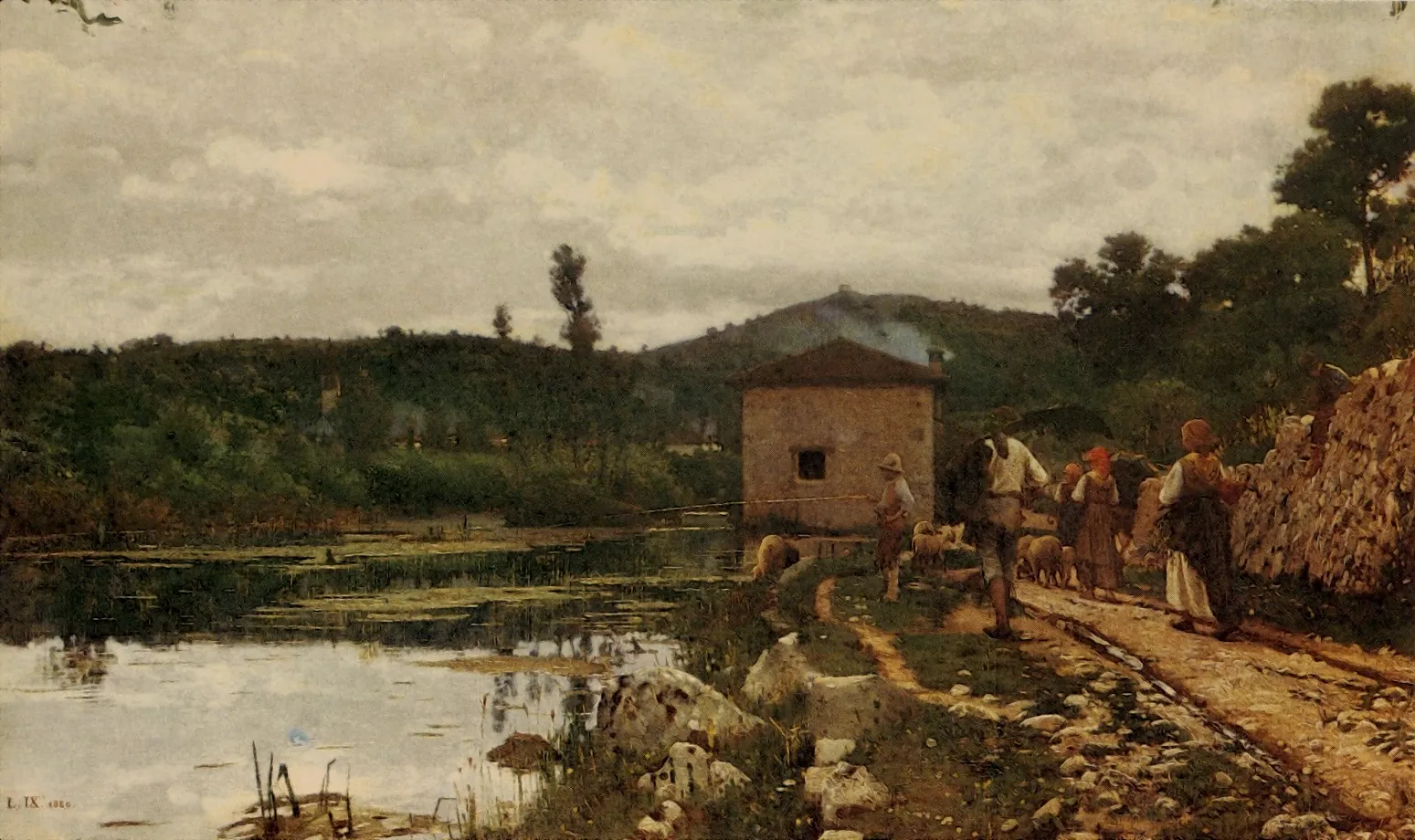

The Livenza
The Gorgazzo, the Santissima and the Molinetto join within a few kilometres to make the Livenza, a river with no mountain stretch: it is born wide, cold and full, which is why boats could use it from ancient times (Visit Sacile).
- The Santissima The river’s main source rises from many small vents packed so close they look like one great mouth, then gathers at once into a river (FAI). Beside it stands the Renaissance church of the Santissima Trinità, with a 17th-century wooden altar and a late 15th-century altarpiece (Italia.it). The site has been tied to the cult of spring water and fertility since ancient times, and a disused small power station still stands by the spring (FAI).
- The Molinetto The third spring lies in Caneva (Visit Sacile); its name means “little mill”. The panel gives average water temperatures of 9.5 °C at the Santissima and 11 °C at the Molinetto.
- The name The Romans called it Liquentia, and Pliny wrote of the “Flumen Liquentia ex montibus Opiterginis”, the river from the mountains of Oderzo. It once marked the border between the ancient Veneti and the Celtic Carni (Visit Sacile).
- The course Roughly 110 km past Polcenigo, Caneva, Sacile, Brugnera, Portobuffolè and Gorgo al Monticano to the Adriatic at Porto Santa Margherita, near Caorle; sources give 90–111 km (In3giorni).
- A trade road Under Venice it carried trade with northern Europe. Horses hauled big boats upstream from Venice with goods to sell inland, and the boats came back down loaded with wood from the Cansiglio forest. Sacile’s river dock, Portus Sacili, is today’s Piazza del Popolo (Visit Sacile).
- The end of the river trade The Livenza stayed busy with barges until the late 19th century, when the Venice–Portogruaro and Treviso–Motta railways were built (IGM atlas).
Timber for the Serenissima
The mountain that feeds the Gorgazzo also grew Venice’s oars. The Cansiglio plateau, directly above Polcenigo, was the Republic’s reserved beech forest, the Bosco da Reme di San Marco (“St Mark’s oar forest”), and the Livenza was one of the roads its wood took to the Arsenale (Museo dell’Uomo in Cansiglio).
From tree to galley
- Chosen on the mountain. Oar-makers based in the mountains picked the beeches and oversaw the felling. The huge trunks were split lengthwise into quarters (Forcole).
- Down the slopes. With no road to the Cansiglio until 1882, timber came down by draught animals, sleds and wooden chutes (risine), sometimes over winter ice. Small dams (stue) were opened to flush logs down the side valleys (Museo dell’Uomo in Cansiglio).
- To the water, two ways. Some timber was dragged north-west to Lake Santa Croce and sent down a canal to the Piave, where it was lashed into rafts. The oar poles (stele) went south from the Cansiglio slopes to a port on the Livenza (Scatolificio Udinese).
- Down the Livenza. Rafts could run the river from just below its springs in the early 1800s (Scatolificio Udinese). Boats returning downstream carried Cansiglio wood, and rafts brought timber and wine from the upper Livenza to Venice’s markets (Visit Sacile; Impetodivino).
- Across to the lagoon. From the river port the poles went on by trabaccolo, a coastal sailing boat, to the Arsenale (Scatolificio Udinese).
- Into the Arsenale. The oar-makers inside the Arsenale turned the best lengths into galley oars. Smaller pieces went to dozens of workshops around the city that made oars for lagoon boats (Forcole).
How Venice guarded the forest
- 1420
- Belluno came under Venetian protection, and with it Venice’s interest in the forest grew (MUC).
- 1458
- The Council of Ten took the Alpago forest under its direct control as a bosco bandito, where all activity was tightly policed (MUC).
- 1548
- The Republic declared the Cansiglio public woodland reserved for the Arsenale; boundary stones from that time still stand (Regione FVG).
- 1549–1550
- A forest captain was appointed and the boundaries were surveyed (MUC).
- 1608
- Inspecting it, Belluno’s governor Alvise Mocenigo told the Republic to hold the woods dear “as a precious treasure” (Edatlas).
- 1797
- Venetian rule ended with the Treaty of Campoformido (MUC).
- 1866
- The whole forest became Italian state property (Regione FVG).
- 1966
- The Friulian part, 1,551 ha in Caneva, Polcenigo and Budoia, passed to the new Region (Regione FVG).
Offenders risked having their property confiscated and being exiled, and citizens could denounce them through a letter box (Edatlas). The forest, about 6,570 ha across Friuli and Veneto, is often called the first protected area recognised by a state (FAI).
Did the Livenza build Venice?
Partly. The Livenza and the Cansiglio above it fed Venice with oars, timber, wine and trade, but the piles under the city came from many mainland forests, and the biggest timber artery was the Piave.
- What Venice stands on The city rests on wooden piles driven into the lagoon mud. A 2016 study of piles and planking from five of Venice’s six historic districts found five or six species: alder, larch, oak, pine, elm and spruce, the last probably a later addition (Macchioni, Pizzo & Capretti, CNR). Venice also needed wood for its ships and for dikes against the sea (Edatlas).
- Where most of the wood came from Nearby Alpine and pre-Alpine forests, because rivers kept transport cheap. The Piave was the great conduit: conifers from Cadore were floated loose down its tributaries, lashed into rafts below the Boite confluence and sent on to Venice. Cadore joined the Venetian state in the early 15th century (Bonan, Forum Editrice).
- What else burned it The Arsenale’s shipyards drove demand, but the Murano glassworks and the hearths of one of Europe’s largest cities also ran on wood (Bonan, Forum Editrice).
- What the Livenza gave Beech oar poles from the Cansiglio through a Livenza river port, rafts of timber and wine, and boats carrying Cansiglio wood downstream (see Timber for the Serenissima). Its tributaries, the Gorgazzo among them, drove the mills, sawmills and forges described in Water at work.
So the popular picture of logs floating from Polcenigo to build Venice blends two true stories. The Cansiglio’s beech really did travel by water to the Arsenale, and the Livenza really was a working river to Venice. But the river’s bigger gift was to Venice’s fleet and trade, not to the foundations under its palaces.